




LOW CIBIL SCORE · BORROWER GUIDE
500 CIBIL Loan App: How to Get a Personal Loan with a Low CIBIL Score (Safely)
A 500 CIBIL score doesn't automatically close every door, but it does make the wrong doors look very tempting. Here's what is realistic, what lenders check, and how to avoid fake apps.
📉 CIBIL range 300-900 | 🏛️ RBI-registered lenders only | ⏱️ 9 min read
Searching for a "500 CIBIL loan app" usually means one thing: a bank has already said no, and you need money anyway. It is a stressful place to be, and it is exactly where fake apps and advance-fee scams do their best business. The honest answer is that a personal loan with a 500 CIBIL score is sometimes possible, but only from lenders that look beyond the score, and never with a guarantee. This guide explains where a 500 score stands, what an urgent loan with a low CIBIL score realistically looks like, and how to tell a genuine lender from a trap.
Where a 500 CIBIL Score Actually Stands
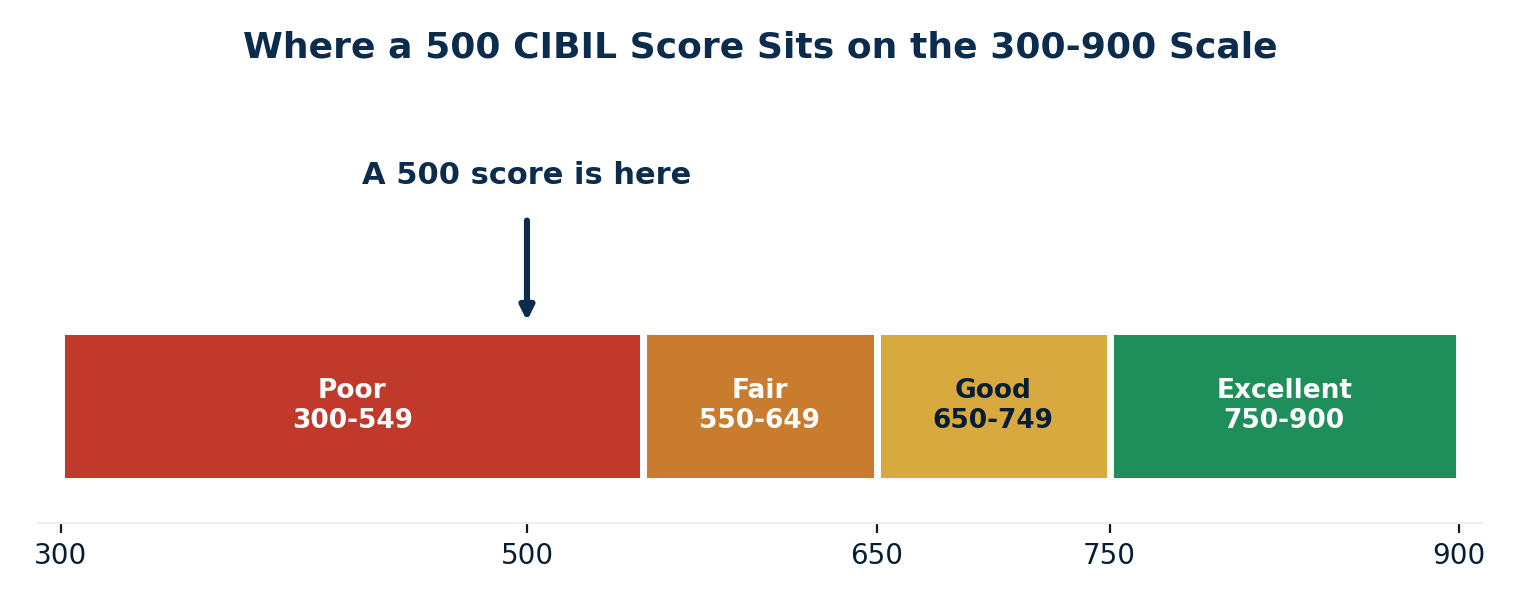
CIBIL scores run from 300 to 900. A score of 500 falls in the "poor" band, which is why most banks decline these applications outright. Here is how the bands are commonly read:
| Score Range | Rating | What It Usually Means When You Apply for a Loan |
|---|---|---|
| 300 - 549 | Poor | Most banks decline. A few RBI-registered NBFCs may still consider you, based on income and banking behaviour, usually with smaller amounts and higher interest. |
| 550 - 649 | Fair | More NBFC options open up. Expect stricter checks and a higher rate than good-score borrowers. |
| 650 - 749 | Good | Banks and NBFCs both consider the application. Moderate rates are possible. |
| 750 - 900 | Excellent | Best chance of approval, larger limits and the lowest rates on offer. |
"CIBIL defaulter" is a loose term, not an official tag. People searching for a personal loan for CIBIL defaulters usually mean a low score after missed EMIs or card payments. That is very different from being declared a wilful defaulter, which applies to deliberate non-payment, mostly on large exposures. A low score is fixable; understanding which situation you are in is the first step.
Can You Really Get a Personal Loan with a 500 CIBIL Score?
Sometimes, yes. Traditional banks rely heavily on the score, so they usually say no. Some RBI-registered NBFCs assess the full picture instead: income, job stability and bank statements. A genuine 500 CIBIL loan app or lender will still run a credit assessment, and approval is never automatic. If a lender promises approval before looking at your documents, treat that as a warning, not good news.
Here is what a lender looks at when your score is low:
| What Lenders Check | Why It Matters When Your Score Is Low |
|---|---|
| Stable income | A steady salary credited every month shows you can service an EMI, whatever the score says. |
| Bank statement health | Regular credits, no frequent bounced payments, and a healthy average balance count in your favour. |
| Existing EMI burden | If a large part of your income already goes to EMIs, approval gets harder at any score. |
| Recent defaults or overdues | Current overdue amounts hurt far more than an old, closed late payment. |
| Number of recent applications | Many applications in a short time create many hard enquiries and signal credit hunger. |
| Loan amount requested | A smaller, affordable amount is easier to approve than a large one. |
What to Expect: Loan Amount, Interest Rate and Tenure
A personal loan with a 500 CIBIL score comes with trade-offs. Being realistic about them protects you from taking a loan you cannot repay:
- Smaller amounts: Lenders usually offer smaller loan amounts to low-score borrowers, because the risk is higher.
- Higher interest: Interest rates are typically higher than what good-score borrowers pay. Always compare the annualised rate (APR), not just the headline rate.
- Tighter tenures: Tenures are often shorter, which means a bigger EMI. Check that the EMI fits comfortably within your monthly income.
- Fees: Processing fees and other charges must be disclosed in the Key Fact Statement before you accept. If the lender will not share one, walk away.
Genuine Lender vs Risky "Guaranteed Approval" App
Low-score borrowers are the main target of predatory apps. This comparison shows what separates the two:
| Factor | Genuine RBI-Registered Lender | Risky "Guaranteed Approval" App |
|---|---|---|
| Approval claim | "Subject to eligibility and verification" | "100% guaranteed, no questions asked" |
| Credit check | Reviews your credit report and income | Claims to skip all checks |
| Fees | Disclosed in the Key Fact Statement | Asks you to pay a fee before disbursal |
| Lender identity | Names the bank or NBFC clearly | Hides or avoids naming the lender |
| App permissions | Only what KYC and verification need | Wants contacts, gallery and call logs |
| Recovery conduct | Contacts you directly and professionally | Threatens you or calls your contacts |
🚨 The One Rule That Avoids Most Scams
A genuine lender never asks you to pay money upfront to "release" or "approve" your loan. Any fee should be disclosed in the Key Fact Statement and adjusted from the loan itself, not transferred to a personal account first.
About the "Bad CIBIL Loan App List": Why Lists Can Mislead
Many borrowers search for a bad CIBIL loan app list. The problem is that app lists go stale fast, and anyone can pay to appear on one. A safer approach is to build your own shortlist using checks that cannot be faked. Confirm the lender is on RBI's list of registered NBFCs, check that the app appears in RBI's Digital Lending Apps directory, and ask for the Key Fact Statement. Our guide on how to compare NBFC loan apps in India walks through each step, and how to identify real vs fake loan apps covers the red flags.
Step-by-Step: How to Apply with a Low CIBIL Score
- 1. Get your free credit report: RBI rules entitle you to one free full credit report each year from each credit bureau. Download it first so you know exactly what lenders will see.
- 2. Check it for errors and dispute them: Wrong entries are common. Under RBI's framework, a complaint about incorrect credit information must be resolved within 30 days, or you are owed ₹100 for every day of delay.
- 3. Clear small overdue amounts: Current overdue amounts weigh heavily. Clearing them before you apply improves your case more than any other single step.
- 4. Verify the lender: Check the lender against RBI's NBFC list and DLA directory before you share any documents or data.
- 5. Apply to one lender at a time: Each application can trigger a hard enquiry. Applying to many apps at once pushes your score lower. Choose one verified lender and apply there.
- 6. Keep documents ready: Keep your KYC, recent bank statements and income proof ready, so a decision does not stall on paperwork. Speed depends on the lender and your documents, and no approval time is guaranteed.
- 7. Borrow only what you can repay: Read the Key Fact Statement, check the APR and total repayment, and borrow only what your monthly income can comfortably handle.
How to Move from 500 to 650+: What Actually Moves Your Score
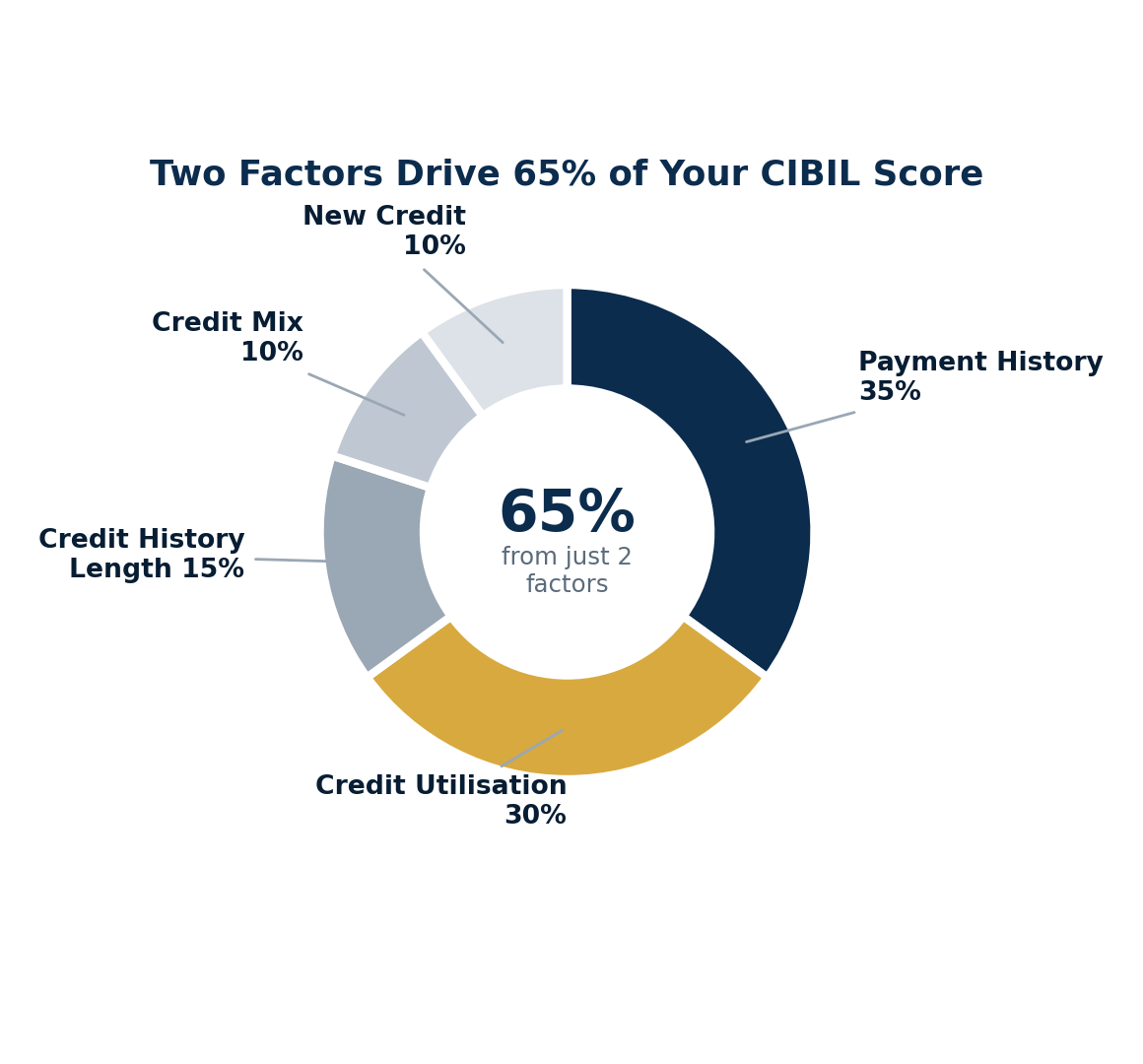
The good news is that your score responds to behaviour. Two factors together account for about 65% of it: whether you pay on time, and how much of your available credit you use.
- Pay on time, every time: Never miss an EMI or card due date. Set auto-debit or reminders, since payment history is the biggest factor.
- Keep utilisation low: Try to use well under 30% of your credit card limit. High utilisation drags a score down quickly.
- Protect history length and avoid new enquiries: Do not close your oldest accounts, and avoid unnecessary new applications.
- Track the progress: Lenders now report to credit bureaus every fortnight, so improvements can appear faster than they used to. No score gain is guaranteed, but steady, on-time repayment is what rebuilds it.
If you do take a loan, repaying every EMI on time can also help rebuild your record, provided the EMI is genuinely affordable. For a deeper look, read our guide on how CIBIL score affects personal loan approval and how to repair a damaged credit score.
CIBIL score of 500 or above?
AFI considers salaried applicants with a CIBIL score of 500 and above, subject to eligibility and verification. 100% digital, with transparent charges. Check Your Eligibility →
Frequently Asked Questions
1. Can I get a personal loan with a 500 CIBIL score?
It is possible but not guaranteed. Most banks decline a 500 score, but some RBI-registered NBFCs assess income, job stability and bank statements along with the score. Expect a smaller loan amount and a higher interest rate than a good-score borrower would get.
2. Which is the best 500 CIBIL loan app in India?
No single app is best for everyone, and any claim of a "best" list should be treated with caution. Instead of trusting a list, check that the lender is an RBI-registered NBFC, that the app is in RBI's Digital Lending Apps directory, and that you receive a Key Fact Statement before accepting.
3. Is there a loan app with no CIBIL check?
Be very careful. Genuine lenders always assess your ability to repay, even if they weigh the score less. Apps that promise "no CIBIL check, guaranteed approval" are often high-cost lenders or scams, especially if they ask for a fee before disbursal.
4. How can I get an urgent loan with a low CIBIL score?
Apply to one verified, RBI-registered lender with your KYC, bank statements and income proof ready, and borrow an amount you can repay comfortably. Speed depends on the lender and your documents. Never pay an advance fee to speed things up.
5. How long does it take to improve a 500 CIBIL score?
There is no fixed timeline, because it depends on your credit behaviour. Payment history makes up about 35% of the score and credit utilisation about 30%, so paying every EMI on time and keeping card usage low is what moves it. Lenders report to credit bureaus every fortnight, so progress can show up sooner than it once did.
Continue Reading on AFI
- Urgent Loan for Salaried Persons with 500+ CIBIL Score — AFI
- CIBIL Score and Personal Loan Approval in India
- Credit Score Repair 2026: Rebuild with Short-Term Loans
- Why Is Credit Score Important?
- How to Compare NBFC Loan Apps in India (2026)
- Real vs Fake Loan Apps in India: How to Identify a Genuine App
- Personal Loan Settlement vs Default: What Happens to CIBIL?
- Instant Personal Loan for Debt Consolidation — AFI
- Private Financer in Delhi NCR for Personal Loan
- How to Apply for an Online Loan
- Instant Loan Online Platform in India
External References
- TransUnion CIBIL — Get Your Credit Score and Report
- RBI — Master Directions on Credit Information Reporting
- RBI — Digital Lending Apps (DLA) Public Directory
- RBI Sachet Portal — Report Suspicious Lending Entities
This article is for informational purposes only and does not constitute financial advice. AFI (Ayaan Finserve India Pvt. Ltd.) is an RBI-registered NBFC (Reg. No. B-14.01220). Loan approval is subject to eligibility, credit assessment and lender policy, and no approval, amount, rate or timeline is guaranteed. Score bands and typical lender behaviour are indicative and based on publicly reported industry practice; actual outcomes vary by lender and individual credit profile.
Share this post: